Bethsaida means "house of fishing" (also rendered "house of hunting") in Hebrew and Aramaic. It was an ancient fishing village on the northern shore of the Sea of Galilee and the hometown of three apostles: Peter, Andrew, and Philip. Excavations at et-Tell have uncovered a first-century settlement that likely corresponds to biblical Bethsaida.
Bethsaida is also known as Beit Saida. The name derives from the Hebrew/Aramaic term “בית צידה” (beth-tsaida), which translates to “house of hunting” or “house of the fisherman.” The Hebrew “beit” means house, while “tzed” can mean both hunting and fishing, giving the name dual significance that reflects the community’s connection to these activities. Archaeological evidence confirms this fishing village’s importance in first-century Galilee, where the apostles Peter, Andrew, and Philip originated before following Jesus.
Location
Bethsaida (Beit Saida) is located near the northeastern shore of the Sea of Galilee. The ancient village is believed to be situated on the northern shore of the Sea of Galilee, though its exact location remains a subject of scholarly debate.
Two archaeological sites near the northeastern shore of the Sea of Galilee, east of the Jordan River, are currently considered the most likely candidates: et-Tell, positioned about 2 kilometers inland from the current shoreline, and el-Araj, located directly adjacent to the modern Sea of Galilee.
2026 update: After years of debate, it looks like el-Araj is probably the correct location. In late 2025, Archaeologists Prof. Mordechai Aviam of Kinneret Academic College and Dr. Steven Notley, academic director of the project, discovered a 5th-century Byzantine church containing a mosaic with a Greek inscription mentioning the preeminence of Saint Peter: “Chief and leader of the heavenly apostles and bearer of the keys of heaven.” This is the earliest archeological evidence that Peter of that believe.
Bethsaida in the Bible
Bethsaida is the third most mentioned city in the gospels after Jerusalem and Capernaum. It is believed to be the hometown of three of Jesus’ apostles: Philip, Peter, and Andrew. According to the New Testament, particularly the Gospel of John (1:44), Bethsaida was the birthplace of these apostles. The town was situated near where the Jordan River flows into the Sea of Galilee on the northern side of the sea.
The Bethsaida biblical site holds profound significance in the New Testament narrative. Jesus performed several miracles in and around this fishing village, including healing a blind man and the miraculous feeding of the 5,000. The town features prominently in multiple Gospel accounts and represented a central hub of Jesus’s Galilean ministry.
Feeding of the 5,000: The northeastern shore of the Sea of Galilee is a fertile plain where the feeding of the 5,000 likely took place. The Church of the Multiplication at Tabgha commemorates this miracle. Gospel accounts specifically mention that Jesus withdrew to “a deserted place belonging to the city called Bethsaida” (Luke 9:10), indicating the miracle occurred within Bethsaida’s territorial boundaries.
Walking on Water: One of Jesus’ most renowned miracles, walking on water, occurred as He was traveling toward Bethsaida, with his disciples witnessing this extraordinary event from the Sea of Galilee. Mark 6:45 records that Jesus instructed his disciples to sail to Bethsaida while he prayed on a nearby mountain.
Healing of the Blind Man: In the Gospel of Mark (8:22-26), Jesus restored the sight of a blind man at Bethsaida, performing this healing miracle in stages, demonstrating both his divine power and compassionate method. This two-stage healing is unique among the Gospel accounts and occurred within the village itself.
Despite witnessing numerous miracles, Bethsaida was among the cities Jesus condemned for their lack of repentance. Jesus criticized the Galilean fishing village of Bethsaida for its inhabitants’ lack of faith, pronouncing woe upon it alongside Chorazin and Capernaum (Matthew 11:20-24, Luke 10:13-15). This condemnation represents those communities that witnessed God’s power yet chose to reject the gospel message.
Around 30 CE, Herod Philip, the son of Herod the Great who governed the area, transformed this fishing village into a city (polis). Josephus reports that Herod Philip renamed the site Julias and increased its population and “grandeur”, honoring Livia-Julia, the wife of Roman Emperor Augustus and mother of Tiberius. This transformation marked Bethsaida’s evolution from a simple fishing community to an important regional center that persisted for several centuries before disappearing from historical records. The elevation to city status brought Roman architectural elements, paved streets, and expanded harbor facilities that supported increased trade along the Sea of Galilee.
Bethesda and Bethsaida are Not the Same!
Bethesda is known as the Pool of Bethesda in Jerusalem, where Jesus healed a paralyzed man (John 5:1-15). The origin of the name “El-Araj” (the paralytic man) comes from confusion in some ancient manuscripts between the names Bethesda, where Jesus healed a paralytic, and Bethsaida, because the two names are similar. Bethesda refers specifically to the healing pools near the Sheep Gate in Jerusalem’s Old City, while Bethsaida was the Galilean fishing village. This confusion persisted in early Christian traditions and continues to affect modern pilgrimage routes. See a comparison between the two sites.
Archeological Findings at Bethsaida
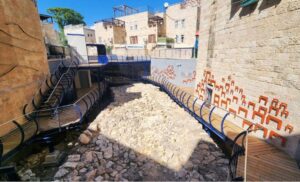
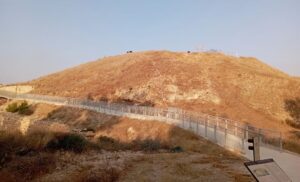
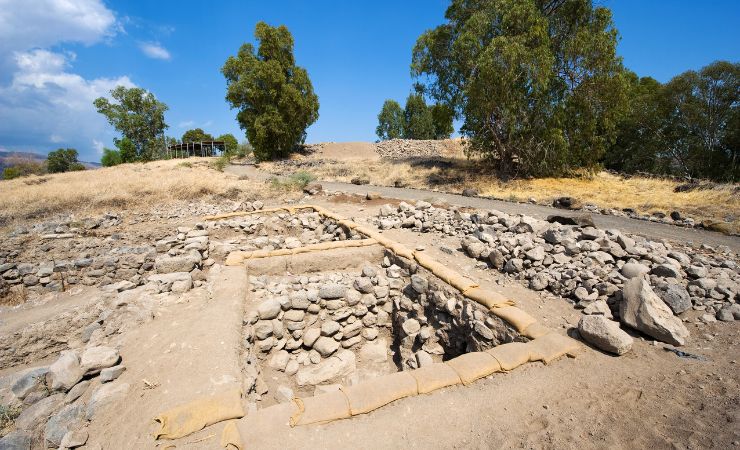
The Bethsaida Excavations Project commenced in 1987, when Dr. Rami Arav proposed that the ancient mound of et-Tell on the north shore of the Sea of Galilee was actually the site of the biblical village of Bethsaida. Et-Tell, the mound identified as ancient Bethsaida, is located on a basaltic spur north of the Sea of Galilee, near the inflow of the Jordan River. The tel covers some 20 acres and rises 30 meters above a fertile valley. Key discoveries include:
City Gates and Walls: One of the significant discoveries at Et-Tell is the city gate from the Iron Age, which is believed to be one of the largest gates found in the region from this period. This four-chambered gate structure and demonstrates Bethsaida’s importance as a fortified city during King David’s era. The gate’s architectural style matches descriptions in 1 Kings and supports biblical accounts of the region’s political significance.
Streets and Public Buildings: The layout of streets and the remnants of public buildings provide clues about the city’s structure and its significance during various periods. Excavators have uncovered a well-planned urban grid with stone-paved streets, public courtyards, and what appears to be a market area near the main gate complex.
Ancient Dwellings: Excavations have uncovered several houses and dwellings, providing insights into the daily life of the inhabitants. These include typical first-century Jewish homes with stone foundations, courtyard layouts, and ritual bathing installations (mikvaot) that confirm the community’s adherence to Jewish law during Jesus’s time.
Fishing Equipment: Given its proximity to the Sea of Galilee and its name’s meaning (“house of fishing”), it’s not surprising that remnants of ancient fishing equipment, including weights and hooks, have been found. Archaeologists have discovered lead net sinkers, iron fishhooks, bronze needles for net repair, and stone anchors that corroborate the Gospels’ descriptions of a thriving fishing industry.
Coins and Pottery: Numerous coins from the Hellenistic and Roman periods have been unearthed, along with a variety of pottery shards, which help date the different occupation layers of the site. Notable finds include Hasmonean coins from the Maccabean period and Roman imperial coins dating to Philip’s transformation of the village into the city of Julias.
Religious Artifacts: Various religious artifacts, including figurines and altars, have been discovered, shedding light on the religious practices and beliefs of the inhabitants. Excavations have revealed both pagan cult objects from earlier periods and evidence of first-century Jewish religious observance, including stone vessels used for ritual purity.
Practical Information
The archaeological sites of Bethsaida are accessible to visitors interested in exploring this significant biblical location. Et-Tell is situated within Jordan Park, a public recreation area near the Yahudia Junction at the intersection of Routes 87 and 92. The site provides parking facilities and walking paths through the excavation areas.
Additional Information
Where exactly was Bethsaida located in biblical times?
Bethsaida was located on the northeastern shore of the Sea of Galilee, east of the Jordan River. Two archaeological sites compete for identification as biblical Bethsaida: et-Tell, situated about 2 kilometers inland, and el-Araj, directly adjacent to the current shoreline. The distance from the water at et-Tell results from geological changes over two millennia, including shoreline shifts due to tectonic activity and sediment deposits.
Which apostles were from Bethsaida?
According to the Gospel of John (1:44), three of Jesus’s twelve apostles originated from Bethsaida: Peter, Andrew, and Philip. These fishermen left their nets and family trade to follow Jesus, making Bethsaida significant as the hometown of one-quarter of the apostolic group. Their familiarity with the Sea of Galilee’s waters proved valuable during Jesus’s ministry around the lake.
What miracles did Jesus perform at Bethsaida?
Jesus performed the two-stage healing of a blind man specifically within Bethsaida (Mark 8:22-26), making it unique among Gospel healing accounts. The feeding of the 5,000 occurred in the “deserted place belonging to Bethsaida” according to Luke 9:10, while Jesus was traveling toward the city when he walked on water. These miracles demonstrate Bethsaida’s central role in Jesus’s Galilean ministry.
Why did Jesus condemn Bethsaida if he performed miracles there?
Despite witnessing multiple miracles, the residents of Bethsaida failed to repent and believe in Jesus’s message. Jesus condemned Bethsaida alongside Chorazin and Capernaum (Matthew 11:20-24, Luke 10:13-15), declaring that even pagan cities like Tyre and Sidon would have responded more favorably. This condemnation illustrates that witnessing divine power without responding in faith leads to greater judgment.
How did Herod Philip transform Bethsaida?
Around 30 CE, Herod Philip elevated Bethsaida from a fishing village to a proper city (polis), renaming it Julias to honor Livia-Julia, wife of Emperor Augustus. This transformation included expanding the population, constructing Roman-style architecture, improving harbor facilities, and establishing paved streets. Josephus records that Philip increased the city’s “grandeur,” making it an important regional center that lasted several centuries.
What archaeological evidence proves Bethsaida’s existence?
Excavations at et-Tell have revealed extensive fishing equipment including lead weights, iron hooks, and stone anchors confirming its identity as a fishing community. Additional finds include Hasmonean and Roman coins, first-century Jewish homes with ritual baths, stone vessels for ritual purity, and a massive Iron Age gate complex. These discoveries align perfectly with biblical descriptions of Bethsaida as both an ancient Israelite city and a first-century fishing village.
Nearby Sites
- Capernaum: Also known as the “Town of Jesus”. This is where Jesus performed many of his miracles. The Church of the Twelve Apostles is based in Capernaum.
- Kursi: Believed to be the location of the “Miracle of the Swine” performed by Jesus in the New Testament.
- Hippos-Sussita: An ancient city that was part of the Decapolis during the Hellenistic and Roman periods.
- Mount of Beatitudes: A hill where Jesus delivered the Sermon on the Mount. It currently houses the Church of Beatitudes designed by Antonio Barluzzi.
- Tabgha: Tabgha is believed to be the site of Jesus’ miracle of feeding the 5,000.
- Domus Galilaeae: Aspiritual retreat overlooking the Sea of Galilee in Israel, offers a serene sanctuary for reflection and prayer.
Keep reading
Part of our Christian Pilgrimage Guide →