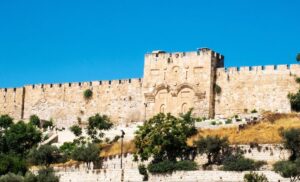
St. George is traditionally buried in Lod, in central Israel, beneath the Greek Orthodox church that bears his name. The church stands over a crypt holding the saint's tomb, drawing Christian pilgrims worldwide to venerate the legendary dragon-slaying martyr.
Beneath a Greek Orthodox church in the ancient city of Lod, about 20 kilometers southeast of Tel Aviv, lies what Christian tradition identifies as the tomb of Saint George, the soldier-martyr whose story has inspired pilgrims, crusaders, and faithful communities for seventeen centuries.
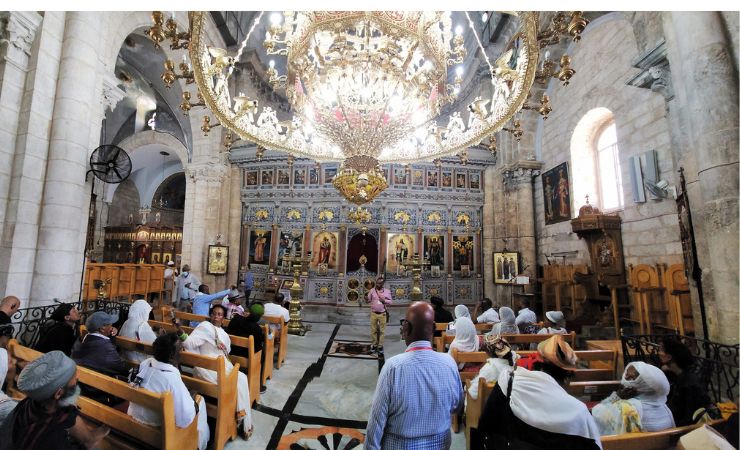
Where Is the Church of Saint George?
The Church of Saint George stands in central Lod (biblical Lydda), approximately 20 kilometers southeast of Tel Aviv and 15 kilometers northwest of Jerusalem. Lod traces its origins to biblical times and is, according to tradition, the birthplace of Saint George around 280 CE.
Who is St. George?
Saint George was born in Lydda around 280 CE to a Roman military officer and a Christian mother from a prominent local family. Historical sources, including the writings of Eusebius of Caesarea, identify him as a Roman cavalry officer who served in the Praetorian Guard under Emperor Diocletian.
When Diocletian issued his first edict against Christians in February 303 CE, George publicly declared his faith and distributed his wealth to the poor. His refusal to sacrifice to Roman gods led to his arrest, torture, and execution on April 23, 303 CE. The early Greek text known as the Passio Georgii details a seven-day ordeal of torment during which, according to tradition, he performed miracles and converted witnesses to the faith.
His fellow believers returned his body to Lydda for burial, establishing the site as a pilgrimage destination within decades of his death. The dragon legend emerged much later, primarily through the Golden Legend of Jacobus de Voragine around 1260, as a symbolic reflection of Christian virtue overcoming evil. At this church, visitors encounter the man behind that legend.
The Building of the Church of Saint George Over Time
The Church of Saint George embodies more than 1,700 years of continuous Christian devotion. Its foundations, both literal and historical, reach back to the earliest centuries of the faith.
Byzantine Period: 5th to 7th Centuries
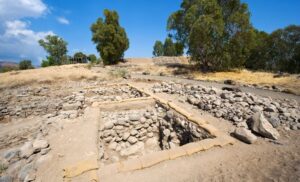
The earliest known church structure dates to the 5th century, when Byzantine Christians built a three-aisled basilica measuring 47 by 24 meters. Each aisle ended in a semicircular apse, with the central apse marking the traditional location of Saint George’s tomb. A smaller subsidiary church stood to the southwest, indicating this was already a major pilgrimage complex.
Writing around 570 CE, the Piacenza Pilgrim described crowds seeking healing at the tomb, noting miraculous cures and precious gifts left by grateful visitors. The basilica functioned for over two centuries until 614 CE, when Sassanid Persian forces under Khosrow II destroyed churches throughout the Levant.
Crusader Period: 12th Century
After the Crusader conquest of the Holy Land, European clergy rebuilt the Church of Saint George. The new structure, completed by 1150, matched the Byzantine basilica’s dimensions while incorporating Romanesque architectural elements and massive stone walls. In 1177, residents climbed onto the church’s flat stone roof for protection during an attack by Saladin’s forces, evidence of its dual role as sanctuary and fortress.
Following the Battle of Hattin in 1187, Saladin captured most Crusader territories and ordered the cathedral demolished in 1191, though he permitted the Greek Orthodox community to maintain the eastern section containing Saint George’s tomb.
Mamluk Period: 13th to 15th Centuries
Under Mamluk rule, the western ruins became a congregational mosque, with the earliest documented reference dating to 1404. Mamluk architects incorporated surviving Crusader columns bearing Greek inscriptions and portions of the original apse. The mosque’s vaulted ceiling retains its cross-shaped configuration, and underground halls originally built by the Crusaders continue to serve as water reservoirs.
This period established the interfaith character that still defines the site. Islamic tradition honors Saint George as Al-Khidr, the immortal guide who aids travelers and warriors, so both Muslim and Christian communities shared, and continue to share, a reverence for this place.
Ottoman Period: 19th Century
The current church emerged during the Ottoman Empire’s Tanzimat reforms, which granted Christian communities greater autonomy over their religious sites. In 1867, the Greek Orthodox Patriarchate of Jerusalem received formal permission from Sultan Abdulaziz to rebuild. Construction ran from 1870 to 1872, using surviving Crusader foundations and architectural elements.
Ottoman records indicate the project cost 30,000 gold pieces, funded by Orthodox communities in Russia, Greece, and the Balkans. The completed church measures 25 by 15 meters and follows traditional Byzantine liturgical arrangements, with an iconostasis separating the nave from the sanctuary.
What Can You See Inside the Church of Saint George?
The interior is intimate, 25 by 15 meters, yet layered with 1,700 years of accumulated devotion. Morning light through the southern-wall windows cuts across stone arches and illuminates the gold leaf on the iconostasis in a way that stops most first-time visitors in their tracks.
The Nave and Architectural Layout — The single nave rises 12 meters to a central dome supported by stone arches that incorporate Crusader-era masonry. The floor is laid with marble in geometric Byzantine patterns, with specialized stone inlays marking the liturgical stations used during Orthodox services. Careful visitors will notice that the stone in the arches changes color slightly where 12th-century Crusader blocks meet 19th-century Ottoman reconstruction.
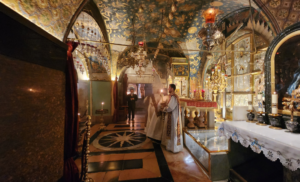
The Wooden Iconostasis — Crafted by Greek artisans and installed in 1873, this ornate screen separates the nave from the sanctuary and is the visual centerpiece of the church. It carries traditional Orthodox icons of Christ, the Virgin Mary, and Saint George depicted in military attire, all framed by mother-of-pearl inlays and gold leaf detailing. The iconostasis represents the celestial court that, in Orthodox theology, mediates between earthly worshippers and the divine.
Byzantine-Style Frescoes — The church walls display frescoes painted in traditional Byzantine style and completed between 1875 and 1880 using egg tempera, a technique well suited to the Mediterranean climate. The apse fresco portrays Christ Pantocrator surrounded by the four evangelists, while side panels illustrate Saint George’s martyrdom and his posthumous miracles. Running your eye along the apse, the sequence of panels reads almost like an early illustrated biography of the saint.
Greek Inscriptions and Medieval Stonework — Several supporting columns bear Greek inscriptions carved from the original Byzantine basilica, including biblical verses and dedicatory texts from early Christian benefactors. The southern wall incorporates stones from the Crusader structure, identifiable by their distinctive masonry marks and slightly different coloration from the surrounding Ottoman-era construction. These elements make the church a physical timeline as much as a place of worship.
The Altar and Elevated Sanctuary — The altar area sits three steps above the nave and contains a marble table consecrated with relics of Saint George and other martyrs, following Orthodox canonical requirements. It stands directly above the traditional tomb location in the crypt below, so the liturgy celebrated at this altar happens, quite literally, over the saint’s burial place.
The Chains of Saint George — Near the church entrance, a glass reliquary holds iron chains traditionally identified as those used to bind Saint George during his imprisonment in Nicomedia. The chains measure approximately 2.5 meters in total length and consist of hand-forged links showing wear patterns consistent with prolonged use. Scientific study of the chains confirmed their age as consistent with 3rd to 4th century Roman metalworking techniques, though their direct connection to Saint George cannot be historically verified. Orthodox faithful attribute healing properties to the chains, particularly for ailments affecting mobility and chronic pain.
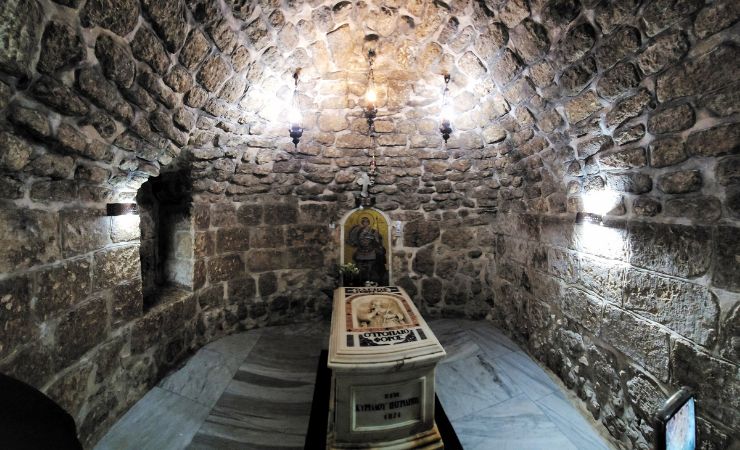
What Is the Crypt of Saint George Like?
The Tomb of St. George
Stone steps worn smooth by centuries of pilgrims’ feet lead down to a vaulted chamber beneath the main altar. A white marble sarcophagus sits directly above the traditional burial location, bearing a Greek inscription in elegant Byzantine script: ὁ Ἅγιος Γεώργιος ὁ τροπαιοφόρος, “Saint George the Trophy-Bearer”, referencing his spiritual victory through martyrdom.
Orthodox tradition holds that this location has remained unchanged since around 327 CE, when Helena, mother of Constantine the Great, identified the site during her pilgrimage to the Holy Land. The chamber maintains a constant temperature year-round. Votive candles and oil lamps cast a soft, steady glow; small silver plaques called tamata, attached to the tomb walls, are gratitude offerings left by pilgrims who believed their prayers were answered here.
“The crypt represents Christianity’s unbroken connection to its martyrs. Here, where George’s body was laid to rest by his fellow believers, pilgrims experience the same devotion that has drawn visitors for seventeen centuries.”
Visiting the Church: Practical Information
Admission is free. The church observes Orthodox liturgical hours, with Divine Liturgy held on Sunday mornings. Dress modestly, shoulders and knees covered, and men should remove hats upon entering. The main church level is partially wheelchair accessible via a ramp, but the crypt has limited accessibility.
Additional Information
Why is Saint George buried in Israel?
Saint George was born in Lydda (modern Lod) around 280 CE and was executed on April 23, 303 CE. Fellow Christians returned his body to his hometown for burial, establishing the site as a pilgrimage destination within decades of his death. The Church of Saint George in Lod has marked that tomb ever since.
Why do Muslims revere Saint George?
Islamic tradition identifies Saint George with Al-Khidr, an immortal figure described in the Quran as a righteous guide who aids travelers and warriors. This parallel veneration has been part of Lod’s religious life since the Mamluk period, when Muslim and Christian communities both maintained a presence at the same sacred site.
What do Muslims call Saint George?
Muslims call Saint George Al-Khidr, meaning “the Green One.” Al-Khidr appears in Islamic tradition as an immortal, divinely guided figure. The shared reverence for this figure explains why the site of the Church of Saint George in Lod has long been honored by both Christian and Muslim communities.
When was the current Church of Saint George in Lod built?
The current structure was built between 1870 and 1872, after the Greek Orthodox Patriarchate of Jerusalem received permission from Sultan Abdulaziz in 1867. It cost 30,000 gold pieces, funded by Orthodox communities in Russia, Greece, and the Balkans, and was built on surviving Crusader foundations.
Is there an admission fee to visit the Church of Saint George in Lod?
No admission fee is required. Visitors should dress modestly, covering shoulders and knees, and men must remove hats inside. The main church level has ramp access, but the crypt below has limited wheelchair accessibility. The church follows Orthodox liturgical hours, with Divine Liturgy.
Can visitors access St George’s tomb in the crypt?
Yes, visitors can descend into the crypt to see St. George’s marble sarcophagus, though access may be limited during religious services. The stone steps are worn and can be slippery, so caution is advised. The crypt is not wheelchair accessible due to the narrow staircase.
Are the chains of St George authentic relics?
The iron chains displayed at St George Church Lod are traditionally venerated as the bonds used during the saint’s imprisonment. While their direct connection to Saint George cannot be historically verified, scientific analysis confirms they date from the 3rd-4th century Roman period. The chains arrived from the Monastery of Saint George at Choziba in 1854, where they had been preserved for over 1,000 years.
Nearby Sites
- Great Mosque of Ramla – Once part of the Crusader church, it retains historical architectural elements and reflects the layered religious history of the city.
- Lod Mosaic Archaeological Center – Home to one of Israel’s most stunning Roman mosaics, with rich animal and marine imagery.
- British Military Cemetery (Ramleh War Cemetery) – A beautifully maintained cemetery with graves of soldiers from WWI and WWII.
- White Tower of Ramla – A 30-meter minaret from the Mamluk era offering panoramic views and a taste of nearby Ramla’s medieval history.
Keep reading
Part of our Shephelah & Central Israel Guide →