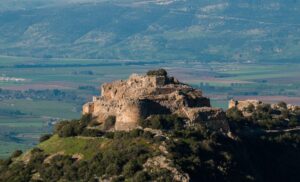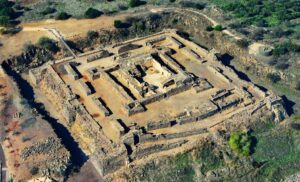
Tel Hazor National Park preserves Israel's largest biblical tel, a UNESCO World Heritage site spanning 200 acres in the Upper Galilee. The ancient city, called "the head of all those kingdoms" in Joshua 11:10, features impressive Canaanite and Israelite remains including a massive water system, city gates, and palaces dating from the 18th century BCE through the 8th century BCE.
Tel Hazor National Park, described in the Bible as “the head of all those kingdoms,” preserves Israel’s largest and most significant archaeological site. This UNESCO World Heritage site offers a profound glimpse into ancient Canaanite and Israelite civilization, revealing layers of human occupation spanning over three millennia. The massive tell covers 84 hectares, making it the largest excavated site in Israel and one of the most important Bronze and Iron Age cities in the ancient Near East.
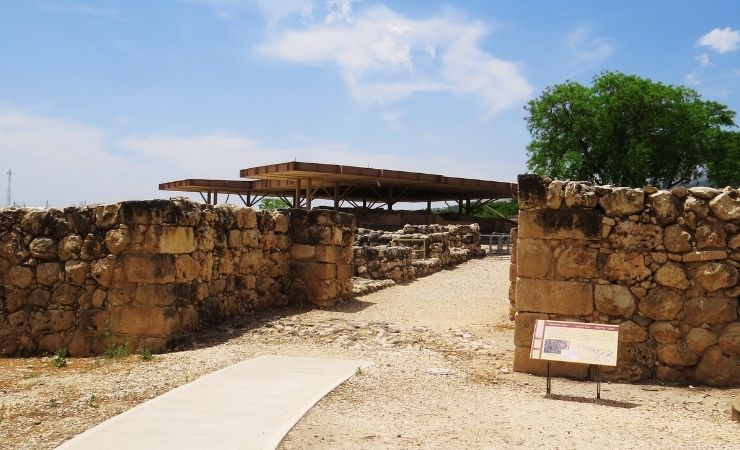
Where is Hazor Located?
Tel Hazor National Park sits in northern Israel’s Hula Valley, approximately 14 kilometers north of the Sea of Galilee near Kibbutz Ayelet HaShahar. The site occupies a strategically vital position that once controlled the ancient Via Maris trade route connecting Egypt to Mesopotamia.
Biblical Context
Hazor occupies a central place in biblical narratives spanning several centuries. In the Book of Joshua, Hazor appears as the most powerful Canaanite city-state, described as leading a coalition of northern kings against the advancing Israelites. The biblical account portrays Joshua’s decisive victory over King Jabin and his commander Sisera, followed by the complete destruction of the city. Archaeological evidence of massive burning and destruction around 1200 BCE.
At that time Joshua turned back and captured Hazor and put its king to the sword. (Hazor had been the head of all these kingdoms.) Everyone in it they put to the sword. They totally destroyed them, not sparing anyone that breathed, and he burned Hazor itself.
Joshua 11:10-11
In Judges 4:2, Hazor resurfaces as the seat of another Canaanite king named Jabin, whose general Sisera commanded 900 iron chariots. This account describes the victory of the prophetess Deborah and general Barak over Sisera’s forces, demonstrating Hazor’s continued importance as a regional power center even after its destruction by Joshua. The biblical narrative reflects the complex political dynamics of the early Iron Age, when Israelite tribes were establishing territorial control in Canaan.
During Solomon’s reign, Hazor regained prominence as one of Israel’s most important fortified cities. First Kings 9:15 lists Hazor alongside Megiddo and Gezer as major construction projects undertaken by King Solomon using forced labor. This rebuilding campaign transformed Hazor into a strategic fortress protecting Israel’s northern frontier.
Here is the account of the forced labor King Solomon conscripted to build the Lord’s temple, his own palace, the terraces, the wall of Jerusalem, and Hazor, Megiddo, and Gezer.
1 Kings 9:15



Hazor Through the Ages
Hazor in the Bronze Age (3rd millennium BCE to 13th century BCE)
Hazor was essentially two cities in one during its Bronze Age heyday. The Upper City, sometimes called the acropolis, was perched atop a hill and covered around 8 to 10 hectares. This elevated district housed the elite quarters: palaces, temples, and administrative buildings where the ruling class conducted affairs of state. Below it, the sprawling Lower City extended across more than 70 hectares, home to the majority of the population and protected by massive earthen ramparts that still dominate the landscape. Together, these urban districts created one of the largest fortified cities in ancient Canaan, covering up to 84 hectares and likely supporting a population between 15,000 and 20,000 people at its peak.
During the Bronze Age, Hazor reached unprecedented levels of power and influence. While the Upper City was first settled in the 3rd millennium BCE, the complete two-part urban complex emerged during the Middle Bronze Age around the 18th century BCE. The scale of construction during this period remains remarkable by any standard. Massive defensive walls, elaborate temple complexes, extensive residential districts, and sophisticated drainage systems all appeared within a relatively short timeframe, suggesting centralized planning and substantial resources that few ancient cities could marshal.
Middle Bronze Age Hazor protected itself with enormous earthen ramparts that enclosed the Lower City, supplemented by a sophisticated moat system on the vulnerable southern approach. These fortifications represent advanced military engineering, designed not only for defense but also to manage water drainage and prevent erosion during the region’s intense winter rains. The city’s gates during this period were relatively simple affairs, featuring direct approaches and functional stone orthostats without the elaborate defensive features that would characterize later periods.
The Late Bronze Age marked Hazor’s golden age as one of the most powerful city-states in the ancient Near East. During this period, monumental buildings appeared throughout the site, including the impressive Canaanite palace complex that still captivates visitors. The city’s wealth came from its strategic position controlling international trade routes, allowing Hazor’s rulers to collect taxes from merchant caravans traveling between Egypt and Mesopotamia.
Hazor’s Bronze Age story ends dramatically around 1200 BCE with evidence of violent destruction that left archaeological scars visible today. Excavators have uncovered a destruction layer reaching up to three meters in depth, filled with burnt mudbricks, charred wooden beams, shattered pottery, and deliberately smashed religious statues. The systematic destruction of cult objects suggests ideologically motivated destroyers rather than simple conquest for plunder. While this destruction layer correlates with the biblical account of Joshua’s conquest, scholars continue debating whether the destroyers were early Israelites, internal revolutionaries, or external invaders during the broader Bronze Age collapse that affected much of the eastern Mediterranean.
The Iron Age: Resettlement and Fortification (c. 12th to 6th Century BCE)
Following the catastrophic destruction that ended the Bronze Age, the Lower City was permanently abandoned while the Upper City experienced gradual resettlement during Iron Age I. The new inhabitants, whether early Israelite settlers or surviving Canaanite populations, lived in simple dwellings and storage pits carved into the destruction debris. These bell-shaped pits, characteristic of early Iron Age sites throughout the Levant, served multiple functions as grain silos, water cisterns, and defensive refuges. Religious practices during this period became more austere, with open-air worship areas and reused Bronze Age standing stones replacing the elaborate temple complexes of earlier eras.
Iron Age II witnessed Hazor’s dramatic renaissance as a major fortified city of the northern Kingdom of Israel. The most impressive surviving structure from this period is the famous six-chambered gate, traditionally attributed to King Solomon’s building program in the 10th century BCE. This massive gatehouse features two imposing towers flanking a passage with three chambers on each side, creating a formidable defensive structure that could accommodate guards, weapons storage, and administrative functions. The gate’s design reflects sophisticated military engineering and urban planning that characterize Solomon’s building projects throughout Israel.
Under King Ahab’s rule in the 9th century BCE, Hazor underwent its most extensive expansion and fortification. The city now spread across the entire Upper City plateau, featuring a impressive citadel, multiple storehouse complexes, and an ingenious water system that remains one of the site’s most remarkable features. The large pillar buildings traditionally identified as Solomonic storehouses may actually have served as military barracks or administrative centers, based on recent analysis of pottery assemblages and architectural details. This period represents the height of Hazor’s importance as a regional administrative center and military stronghold protecting Israel’s northern frontier.
Hazor’s final destruction came between 734 and 732 BCE when the Assyrian king Tiglath-Pileser III conquered the Galilee region and deported its population. Interestingly, the archaeological evidence suggests the city may have surrendered without significant resistance, as the destruction layer lacks the intense burning and debris typical of fierce battles. After this conquest, Hazor never recovered its former importance, though a small settlement persisted on the citadel mound through the Hellenistic period.
What Can Be Seen: The Canaanite Palace
The Canaanite Palace complex represents one of Hazor’s most impressive archaeological discoveries, offering visitors a tangible connection to the city’s Bronze Age glory. Built during the Late Bronze Age (14th-13th centuries BCE), this massive royal residence served as the seat of power for Hazor’s Canaanite kings who controlled the crucial trade routes between Egypt and Mesopotamia. The palace’s strategic location in the Upper City provided commanding views over the Lower City and the surrounding Hula Valley, symbolizing the ruler’s authority over both urban and agricultural domains.
The palace entrance immediately conveys royal power and sophistication through its monumental gateway flanked by two massive basalt pillars. These imposing columns, each weighing several tons, were carefully transported from distant quarries and positioned to create a ceremonial approach worthy of ancient Near Eastern royalty. A grand stone staircase leads visitors through this entrance into the palace’s interior courtyards, where archaeological evidence reveals elaborate stone paving, drainage systems, and room layouts that demonstrate advanced architectural planning.
Within the palace complex, archaeologists have uncovered a formal throne room where the king conducted state business, received foreign dignitaries, and administered justice. Adjacent to this ceremonial space, a raised ritual dais suggests that religious ceremonies played an important role in royal functions, reflecting the common ancient practice of combining political and spiritual authority in royal courts. The palace also yielded numerous artifacts including cylinder seals, Egyptian scarabs, imported pottery, and luxury items that testify to Hazor’s extensive international connections and the wealth of its rulers.
What Can Be Seen: The Water System
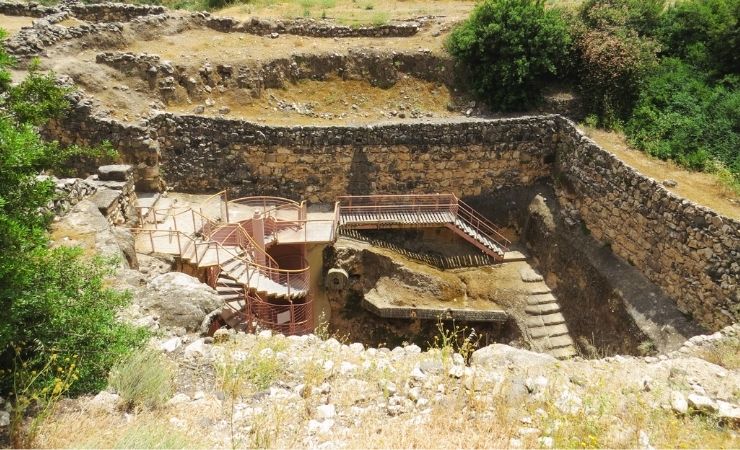
The Israelite Water System at Hazor represents one of ancient Israel’s most impressive engineering achievements, likely constructed during King Ahab’s reign in the 9th century BCE. This remarkable subterranean complex was designed to provide the city’s inhabitants with secure access to fresh water during times of siege, when enemies would typically cut off external water sources. The system demonstrates the sophisticated hydraulic engineering capabilities of ancient Israelite builders and their understanding of local geology and water table dynamics.
The water system consists of three interconnected components that showcase different engineering solutions. The access structure, built with massive dressed ashlar blocks typical of royal construction projects, marks the impressive entrance to this underground marvel. From here, visitors descend into a carefully engineered vertical shaft that plunges 30 meters through accumulated settlement layers down to bedrock level. This shaft features skillfully carved steps along its walls, each approximately 3 meters wide, allowing multiple people to ascend and descend safely even while carrying heavy water vessels.
At the shaft’s bottom, visitors can explore a remarkable horizontal tunnel that extends 25 meters through solid bedrock, sloping gradually downward to reach water-bearing geological layers. Ancient engineers calculated this tunnel’s angle precisely to ensure water would flow naturally toward collection points while remaining accessible to workers who hand-carved the passage using bronze and iron tools.
The water system’s construction required removing thousands of tons of earth and rock, carving through multiple archaeological layers that reveal Hazor’s long occupation history. The system remained functional for decades until Hazor’s destruction by Assyrian forces, after which it was gradually filled with debris and forgotten until modern archaeological excavations revealed this underground masterpiece.
Archaeological Excavations at Hazor
Archaeological work at Tel Hazor National Park began in earnest during the 1950s under the direction of Israeli archaeologist Yigael Yadin, whose systematic excavations established Hazor as one of the most important sites in the Middle East. Yadin’s groundbreaking work from 1955 to 1969 revealed the site’s remarkable stratigraphy, identifying 21 distinct occupation levels spanning from the Early Bronze Age through the Hellenistic period. His team’s discoveries, including the massive Canaanite palace and the impressive Solomonic gate, provided crucial evidence for understanding both biblical narratives and ancient Near Eastern urban development.
Since 1990, Hebrew University’s renewed excavation project under the direction of Professor Amnon Ben-Tor (1953-20223) had continued uncovering Hazor’s secrets using advanced archaeological techniques and interdisciplinary approaches. Recent excavations have focused on refining the site’s chronology, exploring previously unexcavated areas of the Lower City, and investigating the circumstances surrounding the city’s various destruction episodes. These modern investigations employ sophisticated dating methods, computer modeling, and scientific analysis that provide increasingly precise understanding of Hazor’s development and cultural connections.
Practical Information
Tel Hazor National Park is open daily from 8:00 AM to 5:00 PM (April through September) and 8:00 AM to 4:00 PM (October through March), with the last entry permitted one hour before closing time. The park closes one hour earlier on Fridays and holiday eves to accommodate Sabbath observance.
Summer visits require sun protection, plenty of water, and early morning arrival to avoid afternoon heat, as much of the site lacks shade coverage. The water system descent requires reasonable mobility and is not suitable for visitors with claustrophobia or significant mobility limitations. Winter visits offer comfortable temperatures but may involve muddy conditions after rain, particularly around excavation areas and unpaved paths.
Additional Information
How long does it take to visit Tel Hazor National Park?
A thorough visit to Tel Hazor National Park typically requires 2-3 hours, allowing time to explore the Canaanite palace, descend into the water system, walk through the Israelite gate complex, and examine the major archaeological areas.
Is Tel Hazor National Park suitable for children and families?
Tel Hazor National Park welcomes families with children, though parents should supervise young visitors carefully due to uneven ancient surfaces and the deep water system.
How does Tel Hazor connect to other biblical sites in the Galilee?
Tel Hazor National Park forms part of a rich network of biblical and historical sites throughout the Upper Galilee region. The site’s proximity to Capernaum, the Sea of Galilee, and other important locations makes it an excellent addition to multi-day itineraries exploring ancient Israel. Many visitors combine Hazor with nearby Caesarea Philippi, Tel Dan, or Galilee Christian sites to create comprehensive historical tours.
What archaeological artifacts have been discovered at Tel Hazor?
Archaeological excavations at Tel Hazor have uncovered thousands of artifacts spanning three millennia, including Canaanite palace furnishings, Egyptian scarabs, Mesopotamian cylinder seals, elaborate pottery, religious statues, and everyday household items.
Is Tel Hazor National Park accessible for visitors with mobility limitations?
The main archaeological areas of Tel Hazor National Park are accessible via paved and improved paths suitable for most visitors, including those using wheelchairs or mobility aids. However, the famous water system requires descending stairs and is not accessible for visitors with significant mobility limitations.
Nearby Sites
Capernaum: Often referred to as “Jesus’ own city”. It’s renowned for its ancient synagogue and the house of Peter. At Capernaum you can find the Orthodox Church of the Twelve Apostles.
The Church of the Multiplication: Located in Tabgha, this church is believed to be the site where Jesus multiplied the loaves and fishes.
The Church of Beatitudes: Designed by Antonio Barluzzi, this church commemorates the location where Jesus is believed to have delivered the Sermon on the Mount.
Domus Galilaeae: This Christian retreat center offers stunning views of the Sea of Galilee. It’s a place of reflection and spiritual renewal.
Rosh Pina: A picturesque town known for its beautifully restored historic buildings, art galleries, and boutique hotels. It offers a blend of history, culture, and modernity.
Keep reading
Part of our Galilee & Northern Israel Guide →