The Great Mosque of Ramla, also known as El-Omari Mosque, was originally built as a Crusader church in the 12th century before being converted into a mosque under Mamluk rule. The structure represents a rare example of Crusader architecture that survived through various historical periods and remains an active place of worship today.
The Great Mosque of Ramla, also known as the El-Omari Mosque, was originally constructed as a Christian church by the Crusaders in the 12th century, and was later transformed into a mosque under Mamluk rule. This remarkable building remains one of the few complete Crusader structures in Israel.
Location
The Great Mosque of Ramla sits prominently in the historic center of Ramla, a city in Israel’s Central District located approximately 20 kilometers southeast of Tel Aviv’s UNESCO White City. The mosque occupies a central position within the old city area, directly adjacent to the bustling Ramla Market and within walking distance of other significant historical sites including the Pool of Arches and the White Tower.



The History of the Great Mosque of Ramla
Ramla holds the distinction of being the only city in Palestine established by the Arabs, founded between 715 and 717 CE by the Umayyad Caliph Sulayman ibn Abd al-Malik. Named “ar-Ramlah” (the sandy place), the city served as the capital of Jund Filastin, the administrative district of Palestine within the broader Islamic empire. Over the centuries, the city changed hands among various powers, including the Abbasids, Fatimids, Crusaders, Mamluks, Ottomans, and eventually the British during the Mandate period.
During the Crusader period (1099-1187), Ramla emerged as a significant urban center and a vital stopover for Christian pilgrims traveling to Jerusalem’s history. The Crusaders called the city Rama or Ramata and established it as the seat of a bishop. Around 1150 CE, they constructed a magnificent basilica that would later become the Great Mosque of Ramla. This church followed the traditional three-nave basilica plan common in Crusader recent archaeological research and featured sophisticated stone masonry typical of 12th-century Frankish construction techniques.
The transformation from church to mosque began in 1260 when the Mamluk Sultan Baybars recaptured Ramla from the Crusaders. Between 1266 and 1268 CE, the Crusader church underwent conversion into an Islamic house of worship. This transformation involved adding essential Islamic architectural elements while preserving much of the original Crusader structure. Mamluk builders installed a mihrab (prayer niche) oriented toward Mecca, constructed a minbar (pulpit), and later added a minaret in 1314 CE. Arabic inscriptions from 1298 and 1314 CE, still visible within the mosque, commemorate these renovations and mention both Sultan Baybars and his successor Sultan Qatbugha, providing valuable historical documentation of the building’s Islamic period.
Architectural Features
The Great Mosque of Ramla exemplifies the architectural fusion that occurred when Islamic rulers adapted Crusader buildings for Muslim worship. The structure retains its original basilica layout while incorporating essential Islamic elements, creating a unique architectural blend that reflects centuries of religious and cultural transformation.
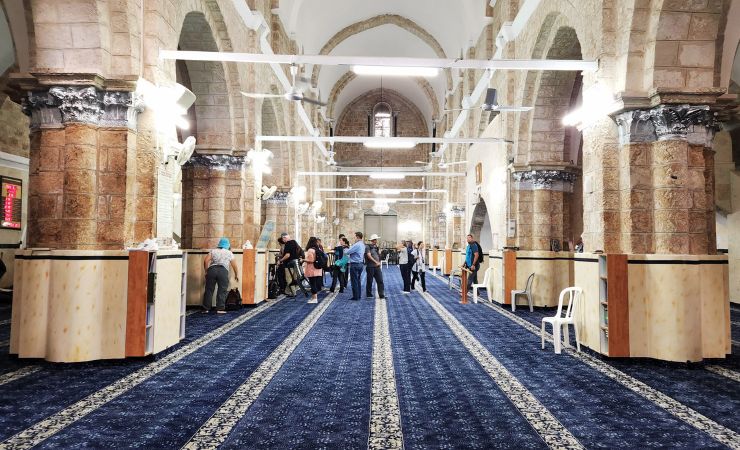
Three Parallel Halls: The building maintains its original Crusader basilica design with a central nave flanked by two side aisles, separated by rows of massive stone columns. These columns display chisel marks and mason’s marks left by 12th-century Frankish stoneworkers, providing tangible evidence of Crusader craftsmanship.
Mihrab: The Islamic prayer niche was carved into the southern wall during the Mamluk conversion, oriented precisely toward Mecca. This marble-decorated recess features geometric patterns and Arabic calligraphy typical of 13th-century Mamluk religious architecture.
Former Apse: The original Crusader apse remains visible on the eastern wall, a large semi-circular niche that once housed the church’s altar. This architectural feature demonstrates how Islamic builders preserved existing structures while adapting them for new religious purposes.
Minbar: Positioned beside the mihrab, this wooden pulpit features intricate geometric inlay work characteristic of Mamluk woodcraft. The imam delivers Friday sermons from this elevated platform, which replaced the original Crusader altar area.
Women’s Prayer Gallery: Located at the mosque’s western end, this elevated section provides a separate prayer space for female worshippers, accessed by a narrow stone staircase built into the original Crusader walls.
Carpeted Prayer Space: The interior floor features prayer rugs arranged in precise rows, each marked to indicate individual prayer positions facing Mecca. These replace the original stone flooring of the Crusader church.
Ablution Courtyard: The outer courtyard contains modern washing facilities where Muslims perform ritual purification before prayer, a requirement not present in the original Christian design.
Minaret: Built in 1314 CE and restored multiple times, this square tower rises approximately 30 meters and serves as the call to prayer. The minaret’s construction required careful integration with the existing Crusader walls.
Quranic inscriptions decorate various walls, including verses from Sura 9, verse 18, while historical inscriptions commemorate Sultan Baybars and subsequent Mamluk renovations. The building’s stone masonry reveals layers of construction from both Crusader and Islamic periods, making it a valuable archaeological resource for understanding medieval construction techniques in the Israel region.
Practical Information
Visiting Hours: The Great Mosque of Ramla welcomes non-Muslim visitors outside of prayer times. The mosque is closed to tourists during the five daily prayer times and on Islamic holidays.
Admission: A small fee is requested upon entry.
Dress Code: Modest dress is required for all visitors. Men should wear long pants and shirts covering their shoulders. Women must wear long sleeves, long pants or skirts, and cover their hair with a provided headscarf. Shoes must be removed before entering the prayer hall.
Accessibility: The main entrance has several steps, making wheelchair access challenging. The mosque courtyard is partially accessible, but the prayer hall requires climbing additional steps.
Additional Information
- First half of the 8th century CE (circa 705-715): Ramla is founded by the Umayyad Caliph Sulayman ibn Abd al-Malik as the capital of Jund Filastin (the district of Palestine) in Bilad al-Sham. It replaces the nearby city of Lydda as the administrative center.
- 1099-1187: Ramla is under Crusader rule. The Christians call the city Rama, Ramata, or Rames and establish a Bishop (Episcopus Ramantis).
- Around 1150: The Crusaders build a large and magnificent church in Ramla, which remains standing today and is a beautiful example of Crusader architecture. This church is later converted into the Great Mosque.
- 1260: Mamluk ruler Baybars conquers the Holy Land, including Ramla. The Mamluks expel the Christians from the Cathedral of Saint John the Baptist (the Crusader church) and convert the building into a mosque, now known as the Great Mosque or al-Jami al-Kabir. Changes include adding a minbar and mihrab. Inscriptions are placed over the northern lintels, commemorating Baybars (western) and Sultan Qatbugha (eastern), dated 1268 and 1298 respectively.
- 1314: The minaret of the Great Mosque is repaired, as indicated by a Mamluk inscription above the entrance gate.
Can non-Muslims visit the Great Mosque of Ramla?
Yes, the Great Mosque of Ramla welcomes non-Muslim visitors outside of prayer times. Visitors must dress modestly, remove their shoes before entering the prayer hall, and respect ongoing religious activities. The mosque is typically accessible to tourists Sunday through Thursday from 9:00 AM to 3:00 PM and Friday from 1:00 PM to 4:00 PM.
What makes the Great Mosque of Ramla architecturally unique?
The Great Mosque of Ramla is one of the few complete Crusader churches in Israel that was successfully converted into a mosque while preserving its original basilica structure. The building uniquely combines 12th-century Frankish stone masonry with 13th-century Islamic additions, including a mihrab, minbar, and minaret. Visitors can still see the original Crusader apse alongside Islamic prayer elements.
When was the Great Mosque of Ramla converted from a church to a mosque?
The conversion took place between 1266 and 1268 CE under Mamluk Sultan Baybars, shortly after the Mamluks recaptured Ramla from the Crusaders in 1260. The Islamic conversion preserved the original Crusader structure while adding essential Muslim worship elements. Arabic inscriptions from 1298 and 1314 CE document subsequent renovations and the construction of the minaret.
Can you see evidence of the building’s Crusader origins inside the mosque?
Yes, numerous Crusader elements remain visible throughout the Great Mosque of Ramla. The original basilica layout with three parallel halls is intact, and the eastern wall still features the Crusader apse. Stone columns display chisel marks and mason’s marks left by 12th-century Frankish builders. The overall architectural plan follows typical Crusader church design, making the building’s Christian origins clearly apparent to visitors.
Nearby Sites
- Pool of Arches: An 8th-century underground water cistern where visitors can enjoy a boat ride amidst ancient arches.
- White Tower: A 13th-century Mamluk minaret offering panoramic views of the city from its summit.
-
British War Cemetery: The resting place of thousands of World War I and II soldiers.
- Franciscan Church and Hospice: Also known as the Hospice of St. Nicodemus and St. Joseph of Arimathea.
Keep reading
Part of our Shephelah & Central Israel Guide →